
VIP observers are lit up by the light of an atomic bomb, Operation Greenhouse, Enewetak Atoll, 1951.
 How To Photograph an Atomic Bomb
 by Peter Kuran VCE, 142 pp.
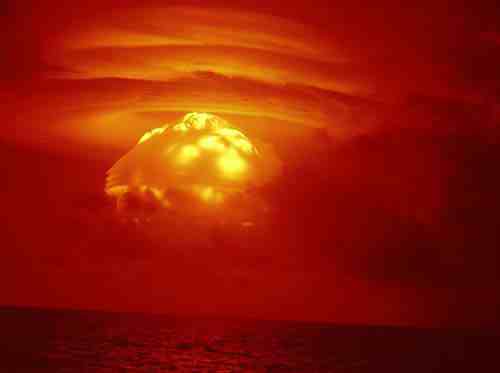
Castle Bravo detonation, March 1, 1954. 15 megatons. Largest nuclear test conducted by the United States.

Troop maneuvers during Operation Tumbler-Snapper were covered extensively by the media including a color featurette entitled “Operation A-Bomb” produced by RKO-Pathe. Twenty-one hundred marines participated in the test. May 1, 1952.

Dominic Truckee, 210 kilotons, Christmas Island Area, June 6, 1962. Speed Graphic camera. Film, Ektacolor.

Five volunteers sent to witness the Genie air strike at ground zero
“One afternoon I was at Lookout Mountain right here in Hollywood, and I got a call from a Woody Mark. He said ‘George, I need you out here tomorrow for a special test.’ I got there that night and he said, ‘Tomorrow morning you’re going to go out with five other guys and you’re going to be standing at ground zero.’ I said, ‘Ground zero?’ He said. ‘Yeah, but the bomb’s gonna go off 10,000 feet above you.’ I said, ‘Well, what kind of protective gear am I going to have?’ He said ‘None.’ I remember I had a baseball hat, so I wore that just in case. He gave me a still camera, and two motion picture cameras. These were 35mm Eyemos. I set up the two Eyemos, and had little trip wires that I could trip with my foot starting about 5 seconds before the blast. And the still camera, I also had a trip wire so that I could trip it. I could get one exposure only. The five other guys were scientists and they volunteered to be there. I wasn’t a volunteer. I didn’t find out until I got there.”
-George Yoshitake

Crossroads Baker, 21 kilotons Bikini Atoll, July 24, 1946.

Plumbbob Hood, 74 kilotons, Nevada Test Site, July 5, 1957.
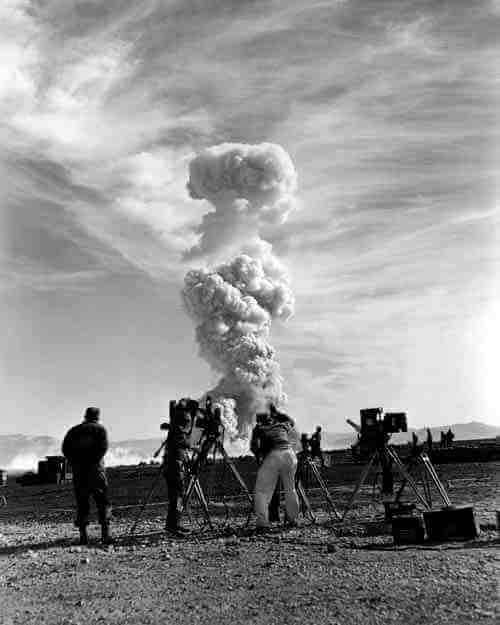
Cameramen photograph shot of Grable at the Nevada Test Site, May 25, 1953.
Nuclear Testing Timeline
Between 1945 and 1962, the United States conducted over 300 atmospheric nuclear tests above the ground, in the ocean or in outer space.
On August 5, 1963, the United States and the former Soviet Union signed the Limited Test Ban Treaty, effectively banning the testing of all nuclear weapons except those tested underground. Atmospheric nuclear test blast photography came to an end.


 Posts
Posts


